SentiLink and DigiFi: Stopping Synthetic Identities Before They Become Charge-Offs
How lenders use SentiLink in DigiFi to catch synthetic identities and identity theft at application, and confirm SSNs directly with the Social Security Administration through eCBSV.
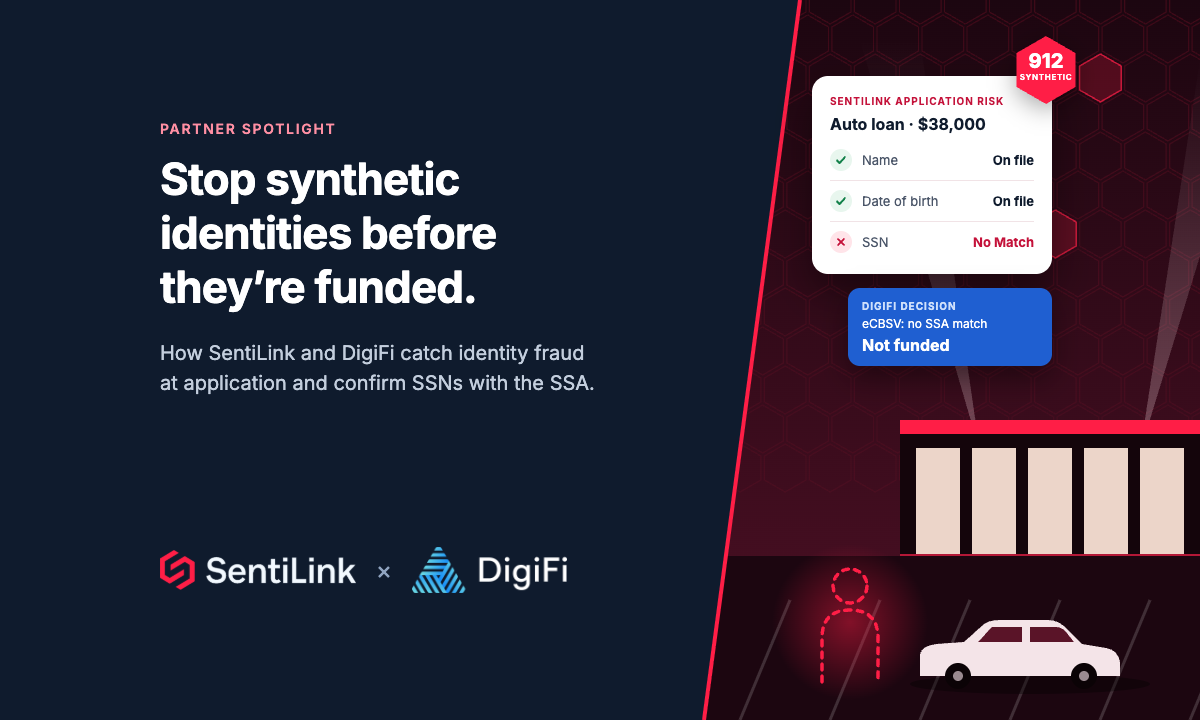
The applicant has a 720 credit score and two years of on-time payments on two credit cards. The name, date of birth, Social Security number, and address all match bureau records, and the identity check comes back clean. The application is for a $38,000 auto loan. Six months later the payments stop, the car is gone, and collections can’t find the borrower, because the borrower never existed.
That is synthetic identity fraud, and it is hard to stop because it looks like good credit. A synthetic identity combines real and fabricated details into a person who doesn’t exist, then builds a credit history patiently enough to pass the checks lenders rely on. According to TransUnion, U.S. lenders had about $2.4 billion in exposure to suspected synthetic identities at the end of June 2026, with auto loans accounting for $1.5 billion of it.
The usual identity checks were built to answer a different question. They confirm that an applicant’s details exist and match records, and a well-built synthetic identity is designed so they do. The harder question is whether those details belong to one real person, and whether that person is the one applying. Answering it without turning away genuine applicants with thin files, such as young adults and recent immigrants, is the real challenge.
DigiFi has an integration partnership with SentiLink, which focuses on synthetic identities, identity theft, and first-party fraud at the application stage. Lenders on the DigiFi loan origination system can add two SentiLink integrations from the Marketplace: Application Risk, which scores each application for fraud risk, and SentiVerify eCBSV, which checks a name, date of birth, and Social Security number directly with the Social Security Administration.
Two Integrations, Two Jobs
SentiLink Application Risk | SentiLink SentiVerify eCBSV | |
|---|---|---|
What it answers | How likely is this application to involve synthetic identity fraud, identity theft, or other identity fraud? | Does this name, date of birth, and SSN combination match Social Security Administration records? |
How it answers | Scores from 0 to 999, with reason codes explaining the main risk factors | A yes or no match, plus a death indicator when SSA records show the number holder has died |
Data source | SentiLink’s models, data, and fraud expertise | The Social Security Administration’s records, through its electronic Consent Based SSN Verification (eCBSV) service |
Typical use | Every application, at submission | Applications that score high for synthetic risk, thin-file applicants, or as a replacement for paper SSA-89 forms |
Application Risk returns SentiLink’s fraud scores. SentiLink’s Synthetic Fraud Score measures how likely an identity is to be fabricated and separates two kinds of synthetic fraud. First-party synthetic fraud is a real person using their own name and date of birth with a Social Security number that isn’t theirs. Third-party synthetic fraud is a fabricated name, date of birth, and SSN combination. SentiLink also offers an Identity Theft Score, which flags applications that use a real person’s identity without their knowledge.
SentiVerify eCBSV gives lenders access to the SSA’s eCBSV service, which lets permitted financial institutions verify a name, date of birth, and SSN combination in real time with the applicant’s consent. SentiLink was the first provider to submit a verification through eCBSV. Before it existed, confirming an SSN with the SSA meant asking the applicant to print, sign, and mail a paper SSA-89 form.
How the Integration Works
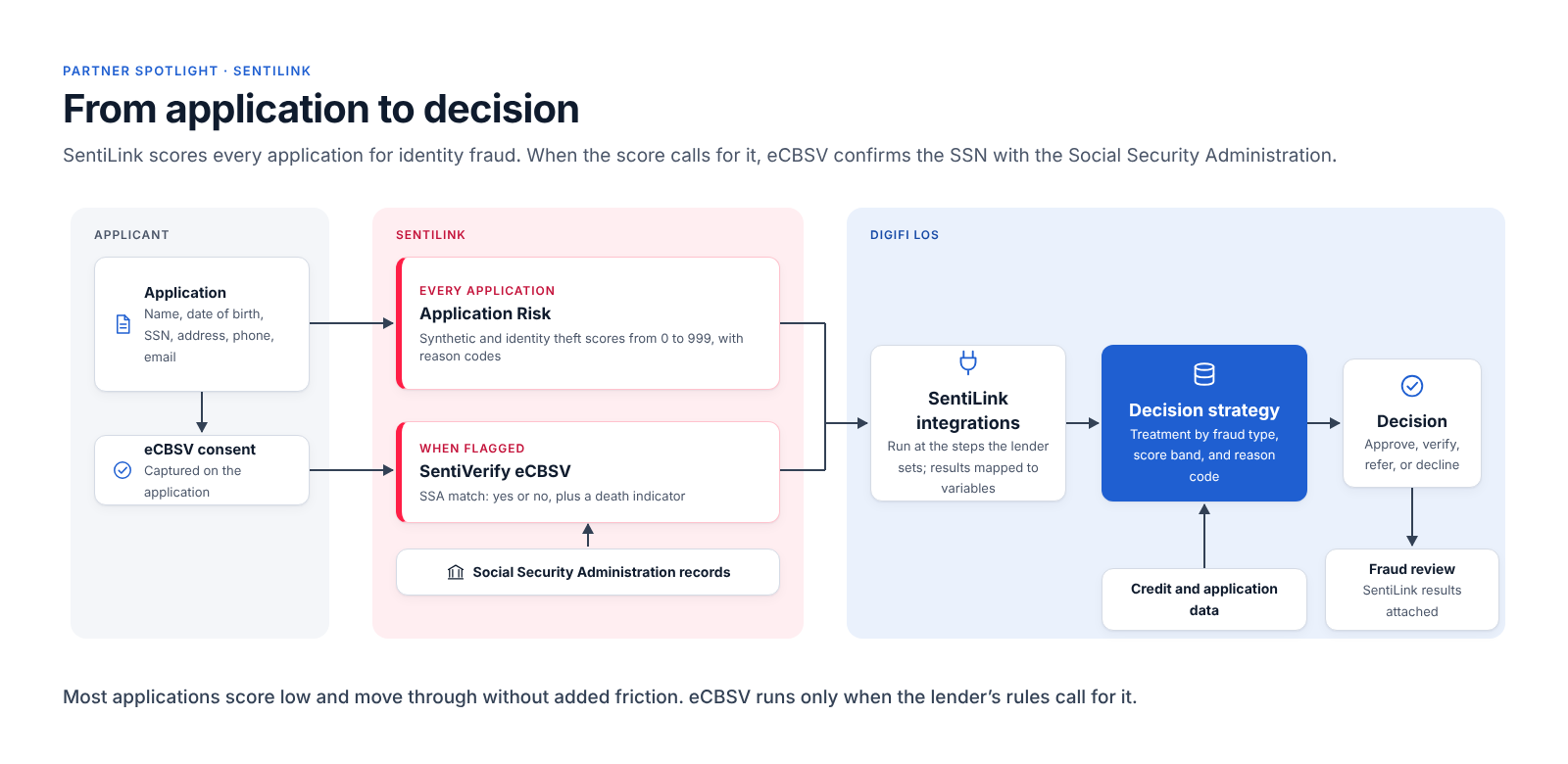
- The lender adds the integrations. Application Risk and SentiVerify eCBSV are added to a loan product from the DigiFi Marketplace and configured with the lender’s SentiLink credentials.
- The applicant applies. The application collects the identity details SentiLink needs, such as name, date of birth, SSN, address, phone, and email.
- Application Risk scores the identity. At the workflow step the lender chooses, DigiFi sends the applicant’s details to SentiLink and receives scores and reason codes.
- eCBSV confirms when needed. For applications that meet the lender’s criteria, such as a high synthetic score or a thin credit file, DigiFi calls SentiVerify eCBSV for an SSA match result.
- The lender’s rules decide. Decision strategies combine SentiLink results with credit bureau and application data to approve, request verification, refer, or decline.
- Exceptions go to reviewers. Referred applications reach a fraud reviewer with SentiLink’s scores, reason codes, and the eCBSV result attached.
Treating Each Type of Fraud Differently
SentiLink separates fraud types because each one calls for a different response. A single “fraud score above X means decline” rule treats them all the same.
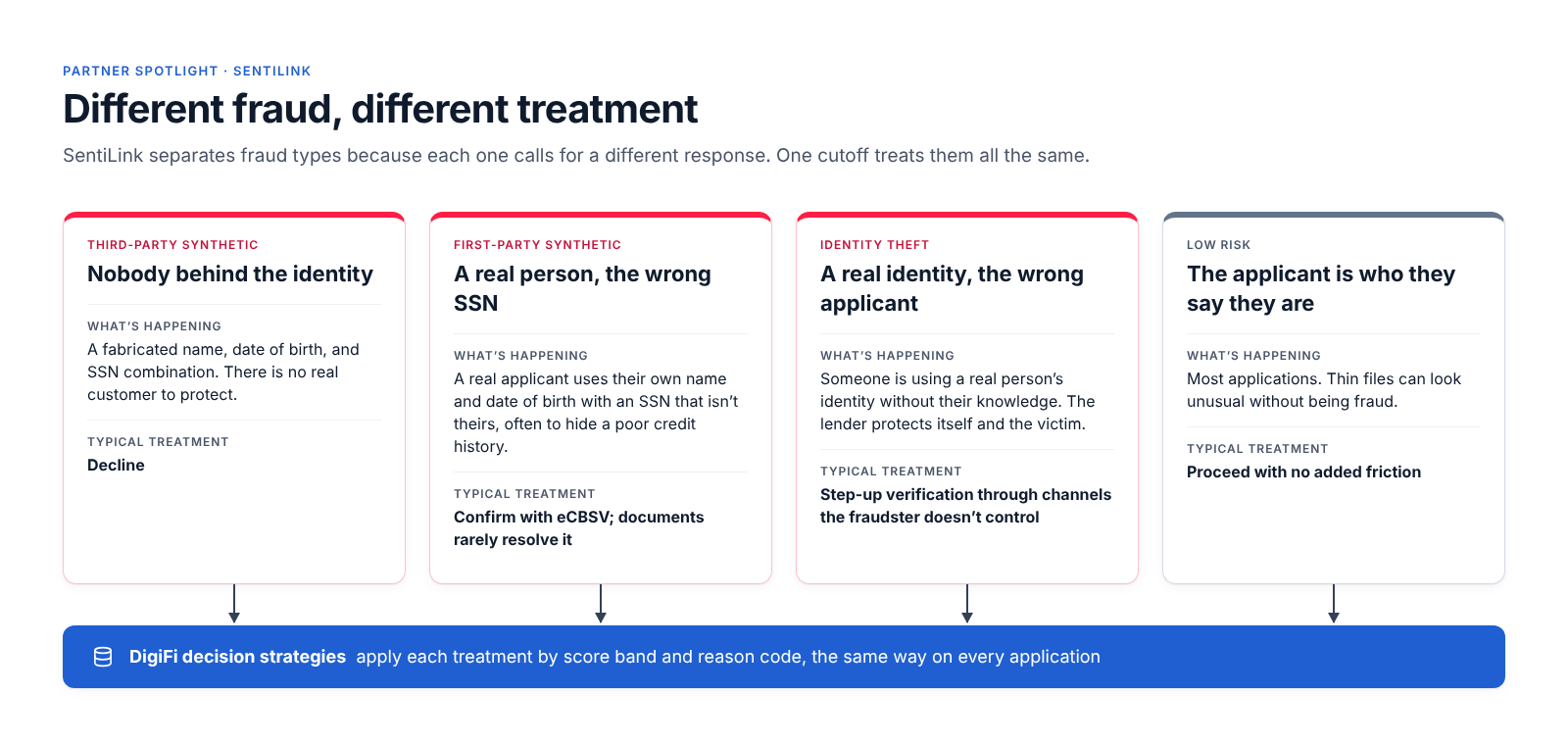
- Third-party synthetic. The identity doesn’t belong to anyone, so there is no real customer to protect. Most lenders decline these applications.
- First-party synthetic. A real person is applying, but with an SSN that isn’t theirs, often to hide a poor credit history. Additional documents rarely resolve this, because the applicant may hold genuine ID in their own name. eCBSV is a direct way to confirm whether the SSN matches the applicant.
- Identity theft. A real person’s identity is being used without their knowledge. Here the lender protects two people: itself, and the victim. Step-up verification through channels the fraudster doesn’t control separates the genuine applicant from the thief.
- Low risk. Most applications score low and should move through with no added friction.
Each of these treatments is a rule in the decision engine, set by score band and reason code rather than a single cutoff.
Trade-offs to Plan For
Thin files are not fraud. Young adults, recent immigrants, and people who have avoided credit can share traits with synthetic identities. Use score bands and reason codes to send borderline cases to verification rather than decline, and monitor approval rates for thin-file applicants.
An eCBSV “no match” is not proof of fraud. Name changes, hyphenated names, and data entry errors can all produce a mismatch. eCBSV also verifies only that the combination matches SSA records, not who is applying. Treat a mismatch as a reason to verify further, not as an automatic decline.
Consent adds a step. eCBSV requires the applicant’s consent, with specific disclosure language. Running it on every application means adding consent to every application. Running it only for flagged applications means asking for consent at a sensitive moment. Choose deliberately.
Cost per check. Each SentiLink product is priced under the lender’s SentiLink agreement, and the SSA charges for eCBSV verifications. Running eCBSV only when Application Risk flags an application keeps costs in line with risk.
Fraud adapts. Synthetic identities are built over months or years to defeat the checks in use. Review thresholds against confirmed fraud outcomes, and keep rules in a decision engine so they can change quickly.
Who Benefits Most
Lender type | Starting point | How they use SentiLink in DigiFi |
|---|---|---|
Auto lenders | The largest share of U.S. synthetic identity exposure, with high balances per loan | Application Risk on every application, with eCBSV for high synthetic scores before funding |
Credit card and personal loan lenders | Synthetic identities that build credit, then bust out | Application Risk at submission, with first-party and third-party synthetic treated differently |
Credit unions and community banks | Membership growth through digital channels, with limited fraud staff | Application Risk to focus reviewers on the riskiest applications, with reason codes to guide each review |
Mortgage and home equity lenders | Paper SSA-89 forms that slow closing | SentiVerify eCBSV as a digital replacement for SSA-89 verification |
Lenders serving thin-file applicants | Genuine applicants who look like synthetic identities | eCBSV to confirm real identities, so more thin-file applicants can be approved |
For Technology Teams
Both SentiLink integrations are Marketplace templates added to a loan product and configured with the lender’s SentiLink credentials. DigiFi maps the application’s identity fields to SentiLink’s inputs, and SentiLink’s scores, reason codes, and eCBSV results come back as application variables for decision strategies, workflow automation, and reports. SentiLink products not yet in the Marketplace can be connected through DigiFi’s data integrations or requested through DigiFi’s support team.
Getting Started
- Confirm your SentiLink products. Agree on products and pricing with SentiLink, and get your credentials.
- Add the integrations. Add Application Risk and, if you plan to use it, SentiVerify eCBSV from the DigiFi Marketplace.
- Collect the right data. Make sure your application captures the identity fields SentiLink needs, and the eCBSV consent if you use it.
- Write your treatment rules. Define score bands for each fraud type, when eCBSV runs, and how each outcome is handled.
- Test, then launch. Run test applications in DigiFi’s testing mode. After launch, track referral rates, confirmed fraud, and approval rates for thin-file applicants.
Existing DigiFi customers typically go live in one to two weeks, and new DigiFi customers in 60 to 90 days.
Return to the $38,000 auto loan. With SentiLink in DigiFi, the application’s synthetic score and reason codes flag it at submission, eCBSV confirms that the SSA has no record of that name, date of birth, and SSN together, and the loan is never funded. Meanwhile, the genuine applicants with thin files get a path to approval instead of an automatic decline.
Frequently Asked Questions
What is SentiLink?
SentiLink is an identity fraud prevention company that helps financial institutions detect synthetic identities, identity theft, and first-party fraud at the application stage.
What is synthetic identity fraud?
Synthetic identity fraud uses a combination of real and fabricated details, such as a real SSN with a different name and date of birth, to create an identity that doesn’t belong to a real person. Fraudsters often build credit under these identities before borrowing heavily and disappearing.
Which SentiLink products are available in DigiFi?
SentiLink Application Risk and SentiLink SentiVerify eCBSV. Other SentiLink products can be connected through DigiFi’s data integrations.
What is eCBSV?
eCBSV, the Social Security Administration’s electronic Consent Based SSN Verification service, lets permitted financial institutions confirm in real time whether a name, date of birth, and SSN combination matches SSA records. SentiLink’s SentiVerify eCBSV integration provides access to it in DigiFi.
Does eCBSV require the applicant’s consent?
Yes. The SSA requires the applicant’s consent before it will verify their information, and accepts electronic signatures.
Does an eCBSV mismatch mean the application is fraudulent?
Not necessarily. Name changes and data entry errors can cause mismatches. Most lenders treat a mismatch as a reason for further verification rather than an automatic decline.
Do I need my own SentiLink contract?
Yes. Lenders contract with SentiLink directly and connect it to DigiFi with their own credentials.
How long does implementation take?
1-2 weeks for existing DigiFi customers. 60-90 days for new DigiFi customers.