DigiFi and Jack Henry: Modern Loan Origination, Connected to Your Core
For banks and credit unions, a loan isn’t finished until it’s in the core. How DigiFi and Jack Henry connect origination with SilverLake and Symitar.
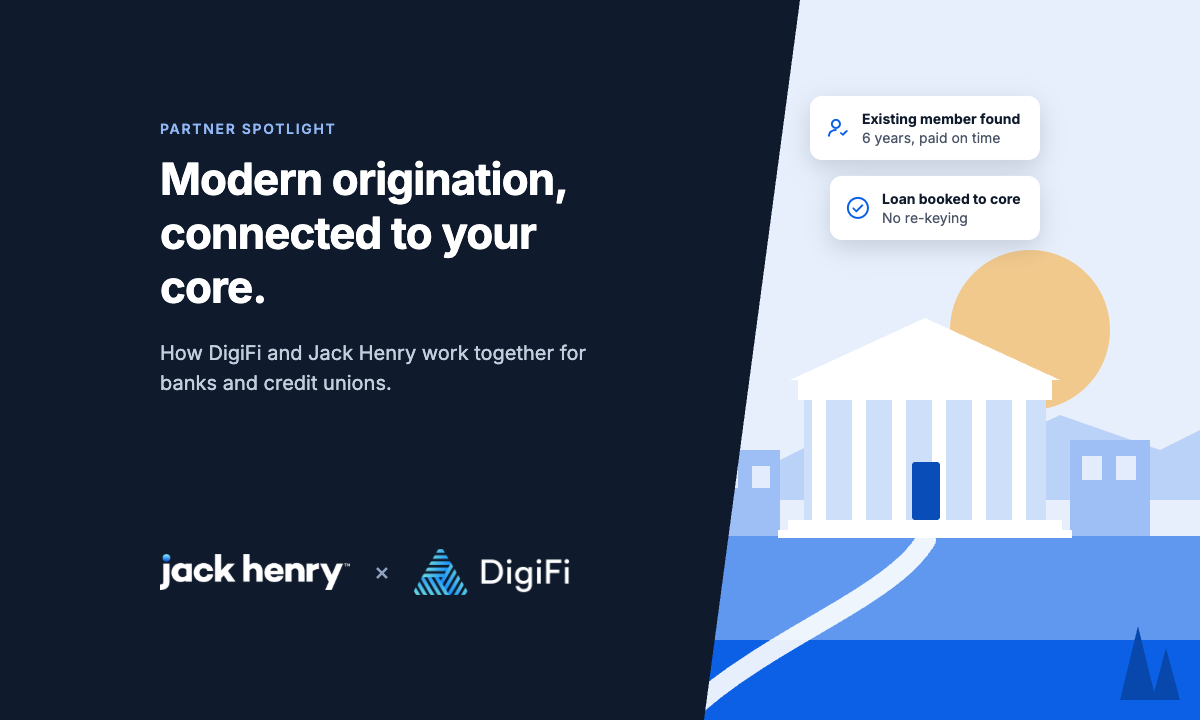
For a bank or credit union, loan origination isn’t complete when it’s approved. It’s finished when it’s in the core.
The core banking system is the institution’s system of record: every customer and member, every account, every loan, every payment. Whatever an origination system decides, the core has to know about it. And the best origination decisions use what the core already knows.
That is why core integrations matter so much for a loan origination system. Without them, an LOS cannot serve most banks and credit unions. With them, origination and servicing work as one system: the LOS reads relationship data during underwriting, and books approved loans into the core automatically.
DigiFi is a certified Jack Henry partner, with integrations for both of Jack Henry’s major core platforms: SilverLake, used primarily by banks, and Symitar, used primarily by credit unions. This post explains how the integration works, why origination and core banking work best as partners, and which institutions benefit most.
The Branch Knew the Member. Now the Core Does.
In a branch, a loan officer often knows the person across the desk: how long they have banked there, what else they hold, whether they have always paid on time. That knowledge is one of the strongest advantages community banks and credit unions have over specialty lenders and fintechs.
In a digital channel, the loan officer is not there. But the knowledge has not disappeared. It lives in the core. Whether a lender can use it in a digital decision depends entirely on whether its origination system can ask the core, in real time, as part of the workflow.
How the Integration Works
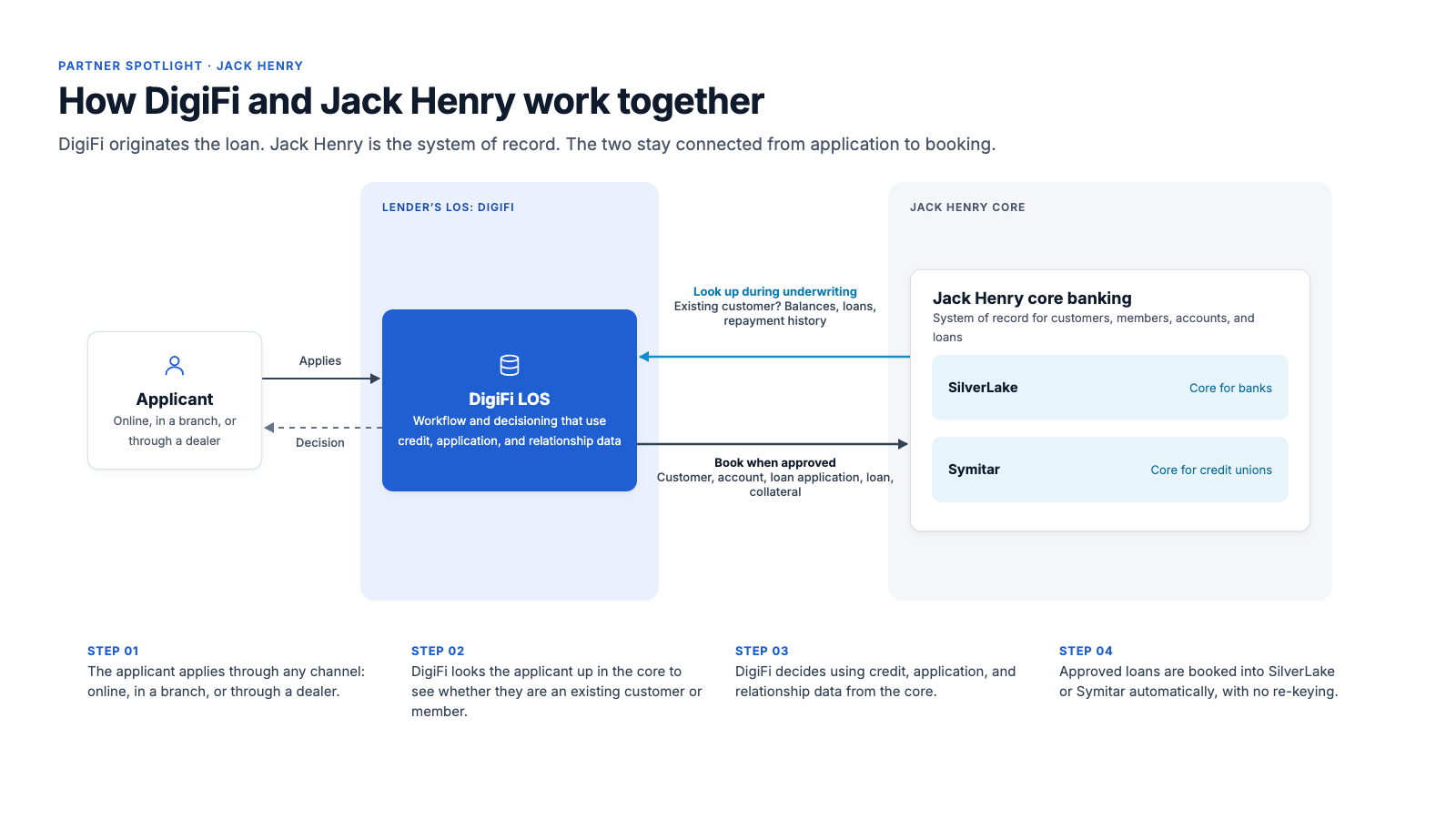
The integration works in two directions.
- Reading from the core during underwriting. When an application arrives, DigiFi can search the core to see whether the applicant is an existing customer or member. Lenders commonly retrieve relationship data as well: how long the applicant has been with the institution, deposit balances, outstanding loans and balances, and repayment history. That data feeds the lender’s decision rules alongside credit, application, and collateral data.
Used well, it supports decisions a lender could never make with credit data alone:
- Relationship-aware approvals. Existing members with a strong repayment history can move through a faster path.
- Relationship pricing. Rates can reflect the depth of the relationship, not just the credit score.
- Total exposure. Limits can account for every loan the borrower already holds with the institution.
- Cleaner records. Matching an applicant to their existing record prevents duplicate customers in the core.
- Writing to the core when the loan is approved. Once a loan is approved, DigiFi creates the records the core needs, without anyone re-keying the application. The integrations available in the DigiFi Marketplace as of this writing are:
Core | Integration | What it does |
|---|---|---|
SilverLake | Search Customer | Searches for an existing customer record |
SilverLake | Create Customer | Creates a new customer record |
SilverLake | Create Account | Creates a loan account |
SilverLake | Create Collateral | Creates a collateral record |
Symitar | Create Account | Creates a new member account |
Symitar | Create Loan Application | Creates a loan application linked to the member account |
Symitar | Create Loan | Creates a loan linked to the member account |
Each integration is attached to a loan product and runs as a step in the lender’s automated workflow, configured through DigiFi’s Data Integrations.
Partners, Not Competitors
Core providers offer broad platforms, and many include origination capabilities of their own. So banks and credit unions sometimes ask whether a specialized LOS duplicates what their core already does.
We think the answer lies in a clear division of labor between best-in-class providers.
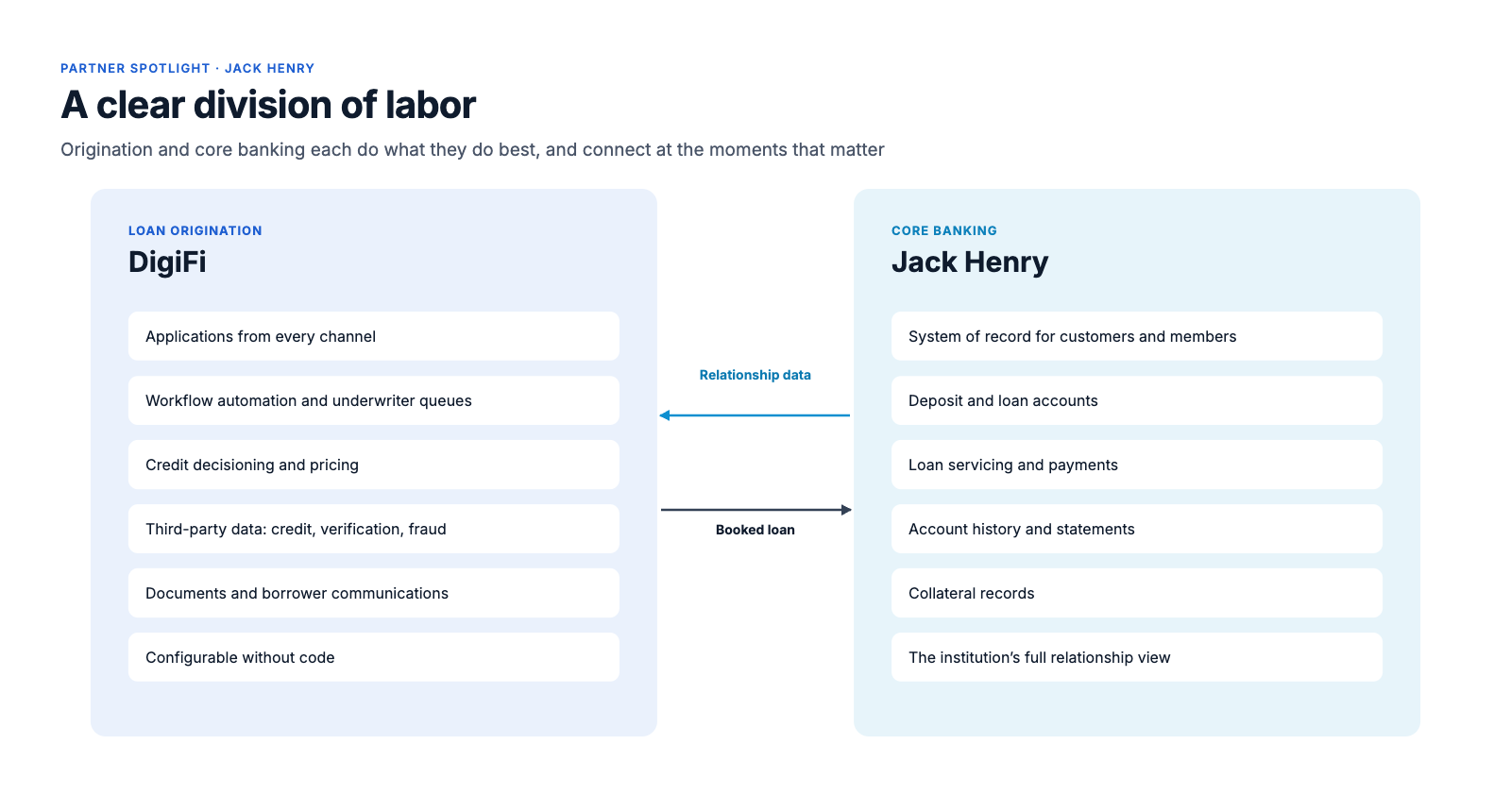
A core platform has to serve the entire institution: deposits, payments, servicing, the general ledger, and much more. A specialized loan origination system can go deeper into origination than would ever make sense for a broader system: configurable decisioning, every application channel, a marketplace of third-party data, and workflow automation that lending teams can change themselves.
DigiFi has no plans to expand into servicing or core banking. That clarity is what makes the partnership work. Each platform does its own job as well as it can, and the two connect tightly at the moments that matter: when the lender needs to know the borrower, and when the loan is booked.
What Certified Partnership Means for Lenders
For a bank or credit union, the riskiest part of any new system is how it connects to the core. Working with a certified Jack Henry partner reduces that risk: the integration has been built against Jack Henry’s interfaces and tested, and it is supported as the platforms evolve. Implementation moves faster because the connection already exists, and the lender’s team can focus on its credit policy and workflows instead of on plumbing.
Who Benefits Most
Institution | Situation | How they use the integration |
|---|---|---|
Credit unions on Symitar | Launching or modernizing digital lending | Book member accounts, applications, and loans automatically, and bring member data into decisions |
Community and regional banks on SilverLake | Automating consumer or small business lending | Find existing customers, then book customers, loan accounts, and collateral without re-keying |
Lenders adding indirect or partner channels | Applications arriving from dealers and other partners | Decide in DigiFi and book every loan into the same core |
Institutions replacing an aging LOS | Want modern origination without changing their core | Replace the origination layer while the core stays the system of record |
Institutions with many loan products | Different workflows for each product | Configure each product’s workflow, and its core integrations, in one LOS |
For Technology Teams
The integrations are configured rather than coded. Each one is added to a loan product in DigiFi and triggered at a defined step in the workflow, with fields mapped between DigiFi’s application data and the core’s records. Additional requests to the core can be configured using DigiFi’s Data Integrations tools.
Getting Started
- Confirm your core. Identify whether you run SilverLake or Symitar, and any connectivity requirements on the Jack Henry side.
- Add the integrations. Choose the Jack Henry integrations you need from the DigiFi Marketplace and attach them to each loan product.
- Map your fields. Agree on how application data maps to customer, member, account, loan, and collateral records in the core.
- Decide how relationship data shapes decisions. Write down exactly how membership, balances, and repayment history affect approvals and pricing.
- Test, then launch. Run applications end to end in a test environment, confirm the records land correctly in the core, and go live.
The core is where the relationship lives. The LOS is where the lending decision is made. Connected, they let a bank or credit union make fast digital decisions using everything it knows about its customers and members.
Frequently Asked Questions
Does DigiFi integrate with Jack Henry?
Yes. DigiFi is a certified Jack Henry partner, with integrations for Jack Henry SilverLake and Jack Henry Symitar.
What is the difference between SilverLake and Symitar?
Both are Jack Henry core banking platforms. SilverLake is used primarily by banks, and Symitar is used primarily by credit unions.
Which Jack Henry integrations are available in DigiFi?
For SilverLake: Search Customer, Create Customer, Create Account, and Create Collateral. For Symitar: Create Account, Create Loan Application, and Create Loan.
Can DigiFi use core data in underwriting?
Yes. DigiFi can look up applicants in the core during underwriting, and lenders can use relationship data such as account history, balances, and repayment history in their decision rules.
Does DigiFi replace the core banking system?
No. DigiFi is a loan origination system. The core remains the system of record for accounts, loans, and servicing, and DigiFi has no plans to expand into servicing or core banking.
How long does implementation take?
1-2 weeks for existing DigiFi customers. 60-90 days for new DigiFi customers.