AppOne and DigiFi: Modernizing Indirect Lending for RV, Marine, and Powersports
One credit application from the dealer, decisions back from every lender in one place. Here’s how AppOne works, and what the integration means for lenders on DigiFi.
When a family decides to buy a travel trailer, a 24-foot center-console boat, or an off-road utility vehicle, they aren’t just buying a vehicle. They’re buying Saturday mornings on the water, summer road trips across the country, and memories with their kids. Yet for years, right at the peak of their excitement, the customer was walked into a cramped finance office for a two-hour gauntlet of disclosures, rate sheets, and redundant verifications.
Behind the showroom doors sits indirect lending: a multi-sided ecosystem connecting retail dealerships with regional banks, credit unions, and specialty finance companies. In automotive, networks like RouteOne and Dealertrack digitized that transaction about two decades ago. Recreational vehicles, marine, and powersports, with their varied collateral and specialized lenders, were largely left to make do with manual workarounds and one lender portal at a time.
AppOne started where every durable business should: with customer friction, working backward. In specialty lending, that friction was felt on every side of the deal:
- Buyers hated waiting.
- Dealers hated re-keying the same application for multiple lenders.
- Lenders hated inconsistent volume and deals stalled in operational purgatory.
AppOne built the connective layer the industry was missing. Dealers submit a single credit application, AppOne routes it to the lenders they choose, and decisions come back in one place. What was once fragmented and manual is now a predictable digital pipeline.
At DigiFi, our mission has always been simple: accelerate lender growth. But great loan origination and automated decisioning software solves only half the equation. Lenders also need a steady flow of high-intent applications from the dealerships where borrowers are actually shopping.
That’s why our new integration with AppOne matters so much, to us and to the lenders we serve. Lenders running on DigiFi can now receive applications from AppOne’s national network of specialty dealers directly in their loan origination system, with no re-keying, and send decisions straight back to the dealer. AppOne built the bridge between dealers and lenders; we’re proud to help more lenders cross it.
This post explains how that bridge works. We cover the customer experience, the AppOne process step by step, how specialty lenders underwrite RV, marine, and powersports loans, where the DigiFi loan origination system fits, the lenders who benefit most, and the metrics that tell you it’s working.
Start With the Customer
The buyer of a boat or an RV wants three things from financing: a fast answer, an attractive offer, and as little paperwork as possible. Everything else is in service of those three things.
Consider what used to happen. The buyer picks a unit on a Saturday afternoon. The dealer’s finance manager types the application into one lender’s portal, then types it again into a second and a third. Some lenders are closed for the weekend. The buyer goes home with a handshake and a promise, and the excitement cools overnight. Some of those buyers never come back.
Now consider the same Saturday with a connected network and an automated lender. The finance manager enters the application once. It reaches several lenders at the same moment. Lenders with automated decisioning can answer in minutes, including on the weekend. The buyer leaves with an approval, a payment they understand, and a delivery date.
Moment in the deal | Fragmented process | AppOne with an automated LOS |
|---|---|---|
Application | Re-keyed into each lender portal | Entered once, sent to many lenders |
Waiting for a decision | Hours to days; often stalls on weekends | Minutes when the lender automates |
Comparing offers | Phone calls and scattered screens | Decisions returned to one place |
Changing the deal | Start over with each lender | Restructure and resubmit from the same application |
Buyer’s experience | Long sit in the finance office, uncertain outcome | Shorter visit, clear answer |
The lesson for lenders is simple. The buyer never sees your loan origination system, but they feel it. Speed and clarity at the dealership are the product.
How AppOne Works, Step by Step
AppOne is a dealer credit application network: one application from the dealer, many possible lenders, one place to see the answers. The process has six steps.
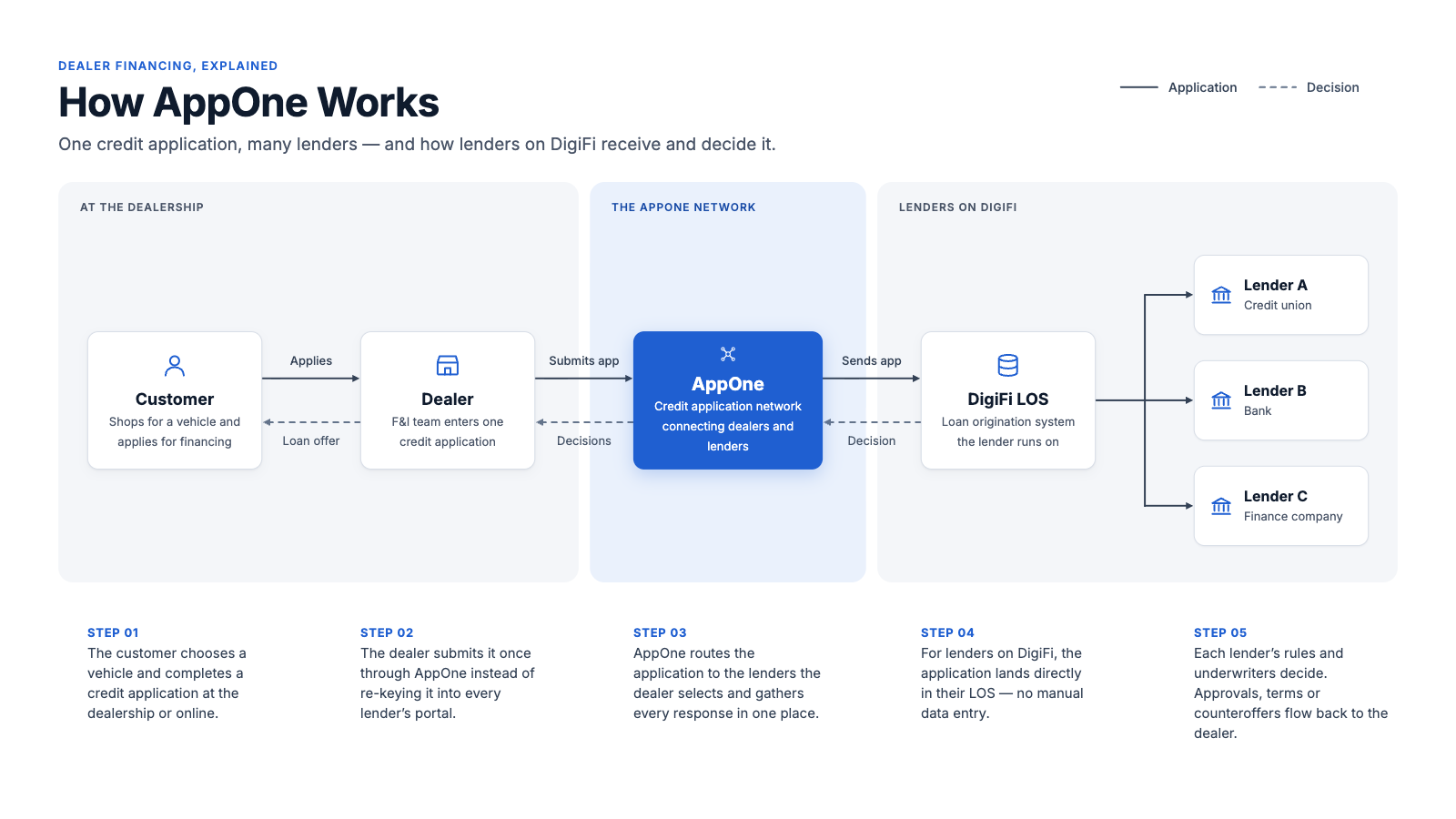
- The customer applies. The buyer completes a credit application at the dealership or, where the dealer offers it, online before the visit.
- The dealer builds the deal. The finance manager enters the applicant and any co-applicant, the unit (year, make, model, and VIN or hull identification number), the price, down payment, trade-in, and add-on products.
- The dealer chooses lenders. From a single screen, the dealer sends the application to one lender or several. There is no re-keying.
- AppOne delivers the application. Each lender receives the same structured data. Lenders on DigiFi receive it directly inside their loan origination system.
- Lenders decide. Each lender applies its own credit policy and returns an approval, a counteroffer, a request for documents, or a decline.
- The dealer closes the deal. The finance manager compares the responses, structures the best option with the buyer, and moves to contracting and funding.
Two details matter more than they appear. First, every lender receives clean, structured data, which removes a common source of errors. Second, the dealer sees every decision in one place, so the lender that answers clearly and quickly has a real advantage.
How Specialty Lenders Underwrite RV, Marine, and Powersports Loans
Every lender on AppOne sets its own credit policy, but most specialty indirect lenders evaluate the same four things: the borrower’s credit, their capacity to pay, the collateral, and the structure of the deal.
Factor | What lenders typically review | Why it matters in specialty lending |
|---|---|---|
Credit | Bureau report and score, payment history, prior installment loans on similar collateral | Recreational purchases are discretionary, so past behavior on comparable loans is a strong signal |
Capacity | Debt-to-income and payment-to-income, stated or verified income | Payments on large RVs and boats can rival a car payment or more |
Collateral | Loan-to-value against published guide values, unit age and condition, a marine survey for some larger boats | Values vary widely by unit type, age, and season |
Structure | Term, down payment, add-on products, dealer participation | Terms on larger RV and marine loans can run far longer than on powersports |
Those inputs lead to one of four outcomes:
- Approve as submitted.
- Counteroffer, such as more money down, a shorter term, or a different rate.
- Refer to a human underwriter for judgment.
- Decline, with an adverse action notice as Regulation B and the FCRA require.
Approved deals usually carry stipulations, such as proof of income, residence, or insurance. The lender clears those stipulations, reviews the signed contract package, perfects its lien on the title, and funds the dealer.
The best lenders automate the clear decisions at both ends and send only the true gray areas to people. That keeps underwriters focused where judgment adds value, and it gives dealers fast answers on the majority of applications.
Where DigiFi Fits: The AppOne Integration
AppOne moves the application from the dealer to the lender. The DigiFi loan origination system is where the lender decides what to do with it. The integration joins the two so the application never has to be retyped.
Here is what happens when an AppOne application reaches a lender on DigiFi:
- The application arrives as structured data. Applicant, co-applicant, collateral, and deal terms land in the right fields of the lender’s DigiFi workspace.
- The lender’s decision strategy runs. DigiFi’s automated decisioning applies the lender’s own rules: credit bureau data, debt-to-income limits, loan-to-value limits, and eligibility by unit type.
- Clear decisions are returned automatically. Approvals, counteroffers, and declines go back to the dealer through AppOne.
- Gray areas go to an underwriter. Referred applications enter a queue with the full file attached, so the underwriter starts with context instead of a blank screen.
- The file moves to funding. Stipulations, documents, and the loan’s history stay in one record from application to booking.
The lender owns its credit policy at every step. DigiFi does not decide who qualifies; it applies the policy the lender sets, consistently and quickly, and records every decision for audit and fair lending review.
The result is a lender that can compete on the dealer’s timeline. When a dealer sends one application to several lenders, a clear answer that arrives first carries real weight.
Who Benefits Most: Primary Use Cases
The integration helps most where a lender wants dealer volume but lacks the systems or staff to handle it manually.
Lender type | Starting point | What changes with AppOne and DigiFi |
|---|---|---|
Credit union expanding indirect lending | Strong member relationships, small lending team, little dealer presence | Reaches specialty dealers without adding staff; automation handles routine applications |
Community or regional bank entering RV or marine | Appetite for well-secured consumer loans, no indirect infrastructure | Launches a new channel on one system, with policy written as rules from day one |
Specialty finance company scaling powersports | High application volume, speed-sensitive dealers | Decides in minutes at scale, including evenings and weekends |
Established indirect lender on a legacy LOS | Existing dealer network, manual workflows, rising costs | Removes re-keying and sends only true exceptions to underwriters |
Lender piloting a new vertical | Wants to test RV, marine, or powersports with limited risk | Starts with conservative rules and a few dealers, then adjusts with data |
The common thread is leverage. Each of these lenders can grow application volume faster than headcount.
The Competitive Landscape
Indirect lending technology has two layers: the networks that carry applications from dealers to lenders, and the loan origination systems where lenders decide. Lenders choose both, and the two choices affect each other.
Dealer-to-lender networks. Several networks connect dealers and lenders, and each has a center of gravity.
Network | Primary focus |
|---|---|
AppOne | Specialty dealers, including RV, marine, and powersports |
RouteOne | Automotive dealers and lenders |
Dealertrack (Cox Automotive) | Automotive dealers and lenders |
CUDL (Origence) | Credit unions lending through auto dealers |
Many lenders participate in more than one network. The right question is not which network wins. It is whether your loan origination system can receive applications from each channel you use without manual work.
Loan origination systems. Lenders generally choose among three kinds of LOS:
- Systems bundled with a core banking platform, which are convenient but often challenging (or impossible) to configure for new channels.
- Legacy enterprise LOS platforms, which are capable but can require long implementations and vendor-led, hardcoded changes.
- Modern, API-first platforms (like DigiFi), which let lending teams change rules and workflows themselves and connect to networks like AppOne through integrations.
For a lender entering or scaling specialty lending, the deciding factors are usually speed to launch, control over credit policy, and the cost of each change after go-live.
What to Measure
Good intentions are not a strategy; metrics are. Lenders who succeed in indirect specialty lending focus on the inputs they control, because outputs like loan volume follow from them.
Metric | Definition | Why it matters |
|---|---|---|
Time to decision | Minutes from application received to decision returned, by day of week | Dealers sell on weekends; a Monday answer to a Saturday buyer often comes too late |
Auto-decision rate | Share of applications decided without human review | Measures how much volume the team can absorb without hiring |
Look-to-book ratio | Applications received per loan funded | Shows whether decisions and pricing actually win deals |
Approval-to-funding rate | Share of approvals that become funded loans | Reveals friction after the decision, such as slow stipulation clearing |
Time to fund | Days from approval to dealer funding | Dealers favor lenders who pay quickly |
Early payment defaults | Loans delinquent in the first months after funding | Confirms that speed is not coming at the cost of credit quality |
Track these weekly and by dealer. The patterns usually point directly to the next rule to tune or the next dealer to call.
Getting Started
A lender can go from decision to live AppOne applications in five steps:
- Join the AppOne network. Work with AppOne to set up your lender relationship and choose the dealers and segments you want to serve.
- Configure DigiFi. Translate your credit policy into decision rules and set up underwriting queues for referrals.
- Connect and test. Turn on the AppOne integration and run test applications end to end.
- Pilot with a few dealers. Start small, review every decision, and tune rules with real data.
- Expand. Add dealers and segments as the metrics above confirm the results.
Return, for a moment, to the family on the showroom floor. They don’t know what a loan origination system is, and they shouldn’t have to. They know they arrived with a dream and left with a clear answer the same afternoon. That outcome is what AppOne built its network to deliver, and it’s what DigiFi is proud to help more lenders provide.
Frequently Asked Questions
What is AppOne?
AppOne is a credit application network that connects specialty dealerships, including RV, marine, and powersports dealers, with indirect lenders. Dealers submit one application and send it to multiple lenders, then see every decision in one place.
What is a loan origination system (LOS)?
A loan origination system is the software a lender uses to receive applications, apply credit policy, make decisions, collect documents, and move approved loans to funding. DigiFi is a configurable, cloud-based loan origination system with built-in automated decisioning.
How does the AppOne and DigiFi integration work?
Applications sent through AppOne arrive in the lender’s DigiFi workspace as structured data. DigiFi runs the lender’s decision rules, returns clear decisions to the dealer through AppOne, and routes exceptions to the lender’s underwriters.
Do lenders give up control of their credit policy?
No. The lender sets every rule, limit, and approval threshold. DigiFi applies that policy consistently and records each decision for audit and compliance review.
What kinds of loans does this support?
The integration is built for indirect consumer loans on RVs, boats, and powersports vehicles sold through AppOne dealers.
Which lenders benefit most?
Credit unions, community and regional banks, and specialty finance companies that want dealer-sourced volume without growing their teams at the same pace.
How long does implementation take?
1-2 weeks for existing DigiFi customers. 60-90 days for new DigiFi customers.