Xactus and DigiFi: One Credit Relationship, Every Credit Option
One relationship, three bureaus: why lenders pull credit through Xactus, and how DigiFi turns every report into an instant underwriting decision.
Nearly every lender on DigiFi pulls credit. What differs is how. Some pull a single bureau, some run a waterfall, and some pull a tri-merge. Some pull credit once; others pull soft early and hard before final approval.
Behind each strategy sits a decision that shapes cost, speed to market, and resilience for years: whether to contract with credit bureaus directly, or to work through a credit reseller.
For many of the lenders we work with, the answer is a reseller. That is why we are proud to partner with Xactus, a credit reporting partner to more than 6,500 U.S. companies. Through Xactus integrations in the DigiFi Marketplace, lenders reach Equifax, Experian, and TransUnion through one relationship, and turn every report into clean data that powers automated underwriting decisions in the DigiFi loan origination system. Existing DigiFi customers can add and configure the integration in one to two days.
Lenders' Choice: Direct to the Bureaus, or Through a Reseller
Every lender must choose whether to work directly with one or more of the three major bureaus, or to pull credit through a reseller like Xactus.
The choice has trade-offs. Going direct often makes sense for lenders with very high volumes, existing bureau contracts, or a need for products only a specific bureau offers. For most other lenders, especially those launching new products or still growing, a reseller is faster and simpler. Here is a summary of the key differences:
Direct with each bureau | Through Xactus | |
|---|---|---|
Relationships | One per bureau, each with its own contract | One relationship for all three bureaus |
Getting started | Separate onboarding with each bureau; a pre-built DigiFi integration for each | One onboarding process; one pre-built DigiFi integration for all three bureaus |
Onboarding time | Longer, and repeated for each bureau | Shorter, with one process |
Pricing at lower volumes | Often the highest tiers until volume grows | Can be more accessible, since resellers aggregate volume across many lenders |
Credit strategies | Waterfall and tri-merge require multiple relationships | Single bureau, waterfall, and tri-merge through one connection |
Bureau downtime | An outage at your bureau stops your credit pulls | Route to another bureau and keep deciding |
Beyond credit | Varies by bureau | Verification, property, and fraud products from the same partner |
A reseller is also a dependency of its own, so lenders should review its uptime commitments, support, and contract terms with the same care they would apply to a bureau.
About Xactus
Xactus traces its roots to 1928. The Xactus brand was unveiled in 2022, following the merger of UniversalCIS and Credit Plus. Headquartered in Broomall, Pennsylvania, with eight operation centers across the United States, Xactus serves more than 6,500 clients across the U.S., including national banks, regional banks, non-bank lenders and loan servicers, credit unions, and mortgage brokers.
Xactus builds its products to run in the background of a lender’s systems and automate approvals. They span four areas:
- Credit analysis: automated credit reports (including tri-merge) and credit scores.
- Verification: digital verification of a borrower’s income, employment, and assets.
- Appraisal and property data: valuations, appraisals, and flood zone certifications.
- Risk and fraud: identity verification, compliance tools, and debt monitoring that flags new borrowing before a mortgage closes.
Three Credit Strategies, One Integration
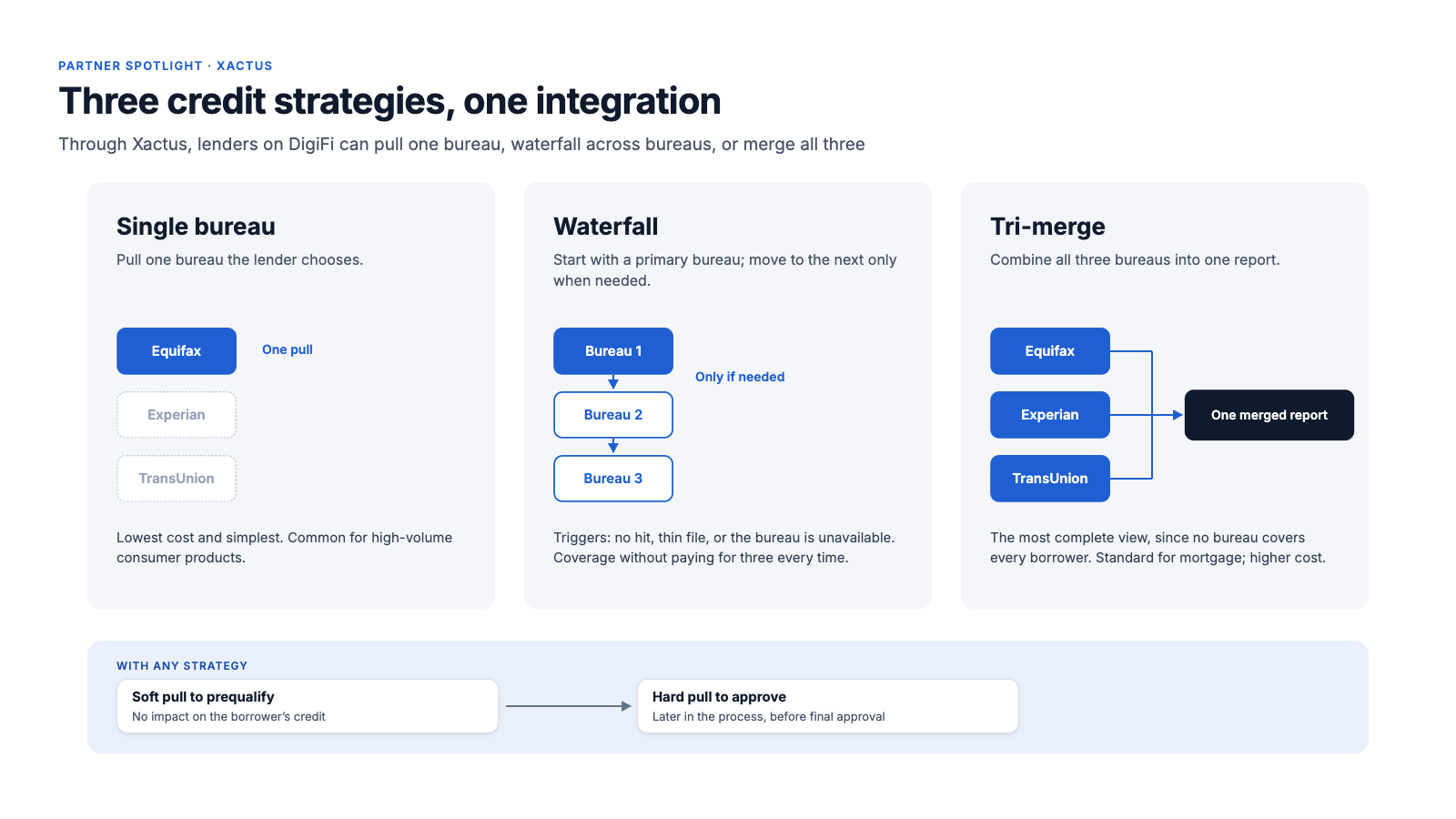
Single bureau. The lender pulls one bureau of its choosing. It is the lowest-cost, simplest option, and the standard for many high-volume consumer products.
Waterfall. The lender starts with a primary bureau and moves to the next only when needed: when the first bureau returns no file, returns a thin file, or is unavailable. A waterfall delivers much of the coverage of three bureaus without paying for three reports on every application.
Tri-merge. The lender combines all three bureaus into one report. Each bureau holds slightly different data, and none covers every consumer in the U.S., so combining them gives the most complete view of a borrower, at a higher cost. Tri-merge is the standard in mortgage lending, where lenders commonly qualify borrowers on the middle of their three scores.
Soft and hard pulls. Xactus offers both. A common pattern, particularly in unsecured consumer lending, is a soft pull early (to prequalify a borrower and present offers without affecting their credit) followed by a hard pull before final approval.
Scores. From each bureau, lenders can pull credit scores such as FICO or VantageScore and use them directly in their underwriting criteria. Because the bureau connection runs through Xactus and the rules live in DigiFi, changing score models or versions is a configuration change, not a new integration. That flexibility matters as score requirements evolve, particularly in mortgage.
The right strategy often differs by product, so a single lender may run all three. That is where orchestration matters.
From Credit Pull to Instant Decision
Inside DigiFi, a credit report is not a document to read. It is data that drives a decision.
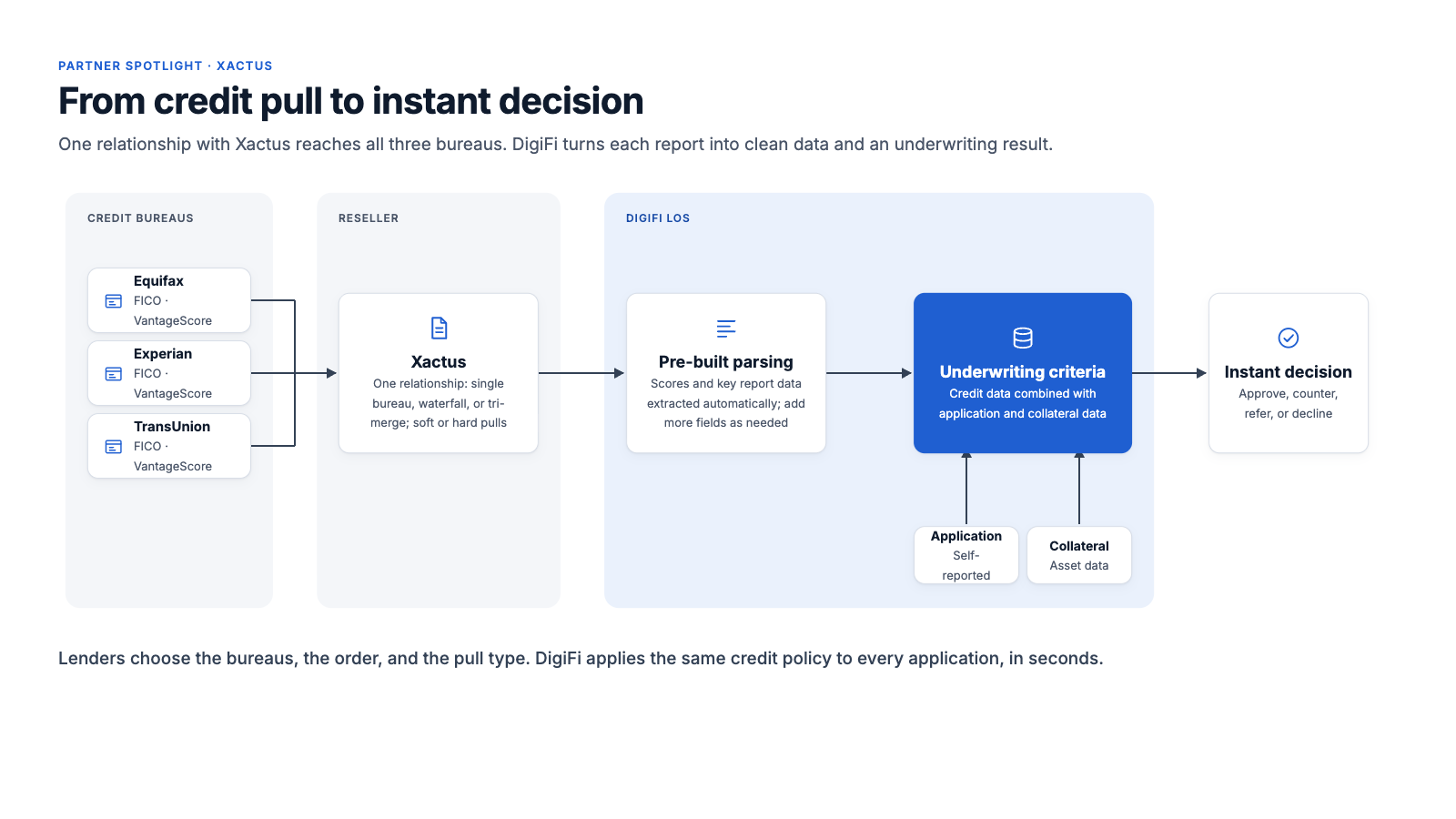
Here's a brief description of the process to retrieve and analyze Xactus credit reports in DigiFi.
- Add the integration. In the DigiFi Marketplace, select the Xactus Credit ReportX card you need, Single Bureau or Tri-Merge.
- Define the credit steps. Decide where soft and hard pulls happen in each loan product’s workflow, and how a waterfall moves from one bureau to the next.
- Pull through Xactus. When an application reaches a credit step, DigiFi requests the report through Xactus automatically.
- Parse the report. DigiFi’s pre-built integrations immediately extract the most relevant information from the report, such as scores, tradelines, balances, inquiries, and delinquencies. Lenders can configure additional data extraction when their criteria need it.
- Apply the underwriting criteria. The parsed credit data feeds the lender’s criteria alongside self-reported application data and collateral data.
- Decide instantly. DigiFi returns an underwriting result, such as approve, counteroffer, refer, or decline, and records the report, the data used, and the rules applied together.
The credit policy runs the same way on every application, in seconds.
For technology teams. The integration is configured, not coded. Credentials, bureau selection, and pull type are set in DigiFi, and parsed fields map into the application’s data model, where rules, workflows, and reports can use them like any other data. Full details are in the Xactus integration documentation.
Designing Your Credit Policy
With every strategy available through one integration, the work shifts from connecting to the bureaus to designing the policy. Five decisions matter most:
- Strategy by product. Which products use a single bureau, which use a waterfall, and which require a tri-merge.
- Pull timing. Where a soft pull belongs, and at what point a hard pull is required.
- Waterfall order and triggers. Which bureau comes first, and exactly which results move an application to the next: no hit, thin file, an unavailable bureau, or a score near a cutoff.
- Scores and data. Which score model and version each product uses, and which report data to extract beyond the defaults.
- Consistency and compliance. Pull credit only with a permissible purpose and the borrower’s authorization. Apply the same strategy to similar applicants. And record which bureau’s report drove each decision, because an adverse action notice must name the bureau and disclose the score used, which matters most when a waterfall can pull from different bureaus.
Each of these is a deterministic rule: written once, tested, and applied the same way every time. That automation logic then belongs in the decision engine.
Who Benefits Most
Lender type | Why a reseller | Typical strategy |
|---|---|---|
Growing lenders and fintechs | Faster onboarding and pricing that is accessible at lower volumes | Soft pull to prequalify, single-bureau hard pull to approve |
Credit unions and community banks | One relationship for every product they offer | Single bureau for consumer loans, tri-merge for mortgage and home equity |
High-volume consumer and auto lenders | Coverage and resilience at scale | Waterfall to handle no-hits, thin files, and bureau downtime |
Mortgage and home equity lenders | Tri-merge as standard, with verification products from the same partner | Tri-merge with the middle score |
Lenders launching new products | Speed to market | Start simple, then add a waterfall or tri-merge as data accumulates |
Beyond Credit
Xactus’s verification, property, and fraud products can be connected to DigiFi manually through data integrations, or lenders can ask DigiFi customer support to add a product to the Marketplace. Consolidating these services with the same partner that provides credit can simplify vendor management as a lender grows.
Getting Started
- Set up your Xactus account. Contact Xactus to establish your credit reporting relationship.
- Add the integrations. Choose Xactus Credit ReportX – Single Bureau, Tri-Merge, or both from the DigiFi Marketplace. Existing DigiFi customers typically add and configure the integration in one to two days.
- Write your credit strategy as rules. Strategy by product, pull timing, waterfall triggers, and scores.
- Test end to end. Run sample applications through every path, including no-hits and thin files, and confirm the right report is pulled and the right decision follows.
- Go live and measure. Track time to decision, no-hit and thin-file rates by bureau, cost per decision, and how often the waterfall moves past the first bureau.
For most lenders, the question is no longer whether to automate credit pulls. It is how much of their credit policy they can put to work automatically, and how quickly. With Xactus and DigiFi, the answer can be all of it, from the first launch.
Ready to connect? Book a DigiFi demo.
Frequently Asked Questions
What is a credit reseller?
A credit reseller provides access to the credit bureaus’ data through a single relationship, often adding tri-merge reports, score options, and other data services. Xactus is a credit reseller and verification provider.
Why use a reseller instead of going directly to the bureaus?
A reseller provides one relationship for all three bureaus, typically faster onboarding, pricing that can be more accessible at lower volumes, and the flexibility to run single-bureau, waterfall, and tri-merge strategies through one connection.
What is a credit waterfall?
A waterfall starts with a primary bureau and pulls from the next bureau only when needed, such as when the first returns no file, a thin file, or is unavailable.
What is the difference between a soft pull and a hard pull?
A soft pull does not affect the borrower’s credit and is often used to prequalify. A hard pull is used before final approval and appears on the borrower’s credit report as an inquiry. Xactus offers both.
Which credit scores can lenders use?
Lenders can pull scores such as FICO or VantageScore from each bureau and use them in their underwriting criteria.
Does Xactus offer more than credit reports?
Yes. Xactus also offers verification of income, employment, and assets; appraisal and property data; and risk and fraud tools. Within DigiFi, these can be connected through data integrations or requested for the Marketplace.
How long does setup take?
Existing DigiFi customers can typically add and configure the Xactus integration in 1-2 days. New DigiFi customers typically go live in 60-90 days.