What Lending Looks Like in 2035
AI agents, headless lending, and the unconditional loan: a look at lending in 2035, and what lenders should start doing now.
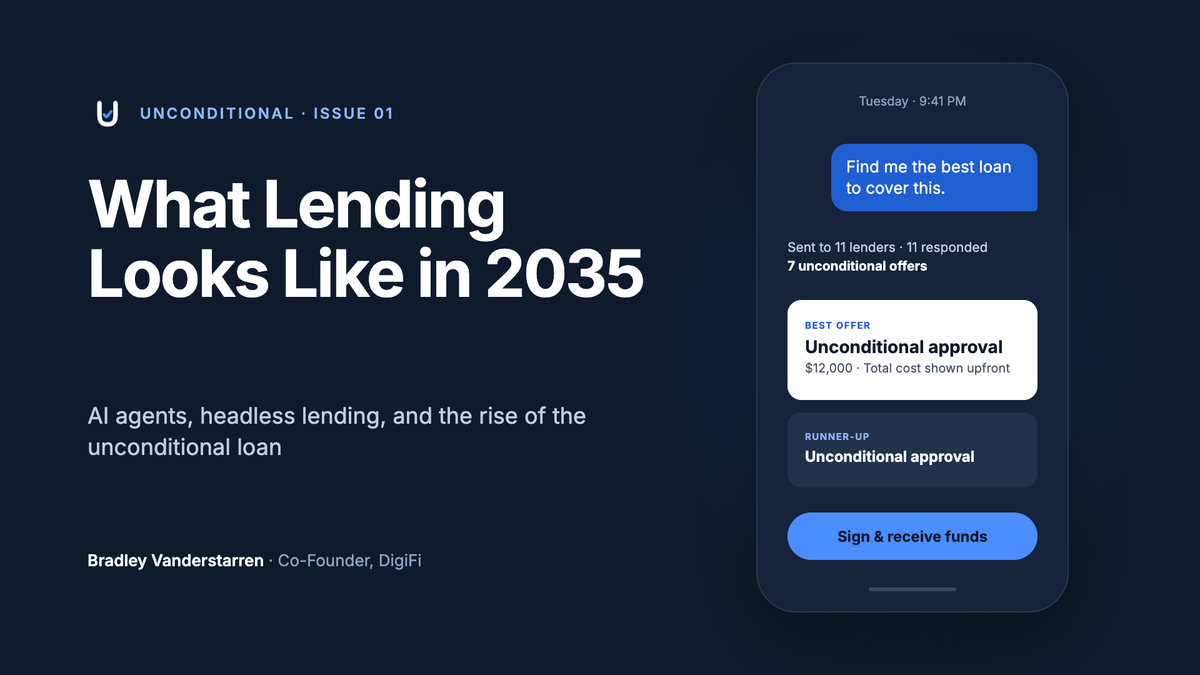
This article was originally published as Issue #1 of Unconditional, a newsletter by DigiFi co-founder Bradley Vanderstarren. Subscribe on LinkedIn to read future issues first.
Tuesday Evening, 2035
It’s a Tuesday evening in 2035. Maya’s furnace has failed, and the replacement will cost $12,000 – money she doesn’t have. She doesn’t open a banking app. Instead, she tells her personal AI assistant, her agent: “Find me the best loan to cover this.”
In the next thirty seconds, her AI agent submits applications to eleven lenders, sending information the agent already knows: Maya’s personal details, verified income, and verified identity. All eleven respond, including seven with unconditional offers. The AI agent excludes one lender with weak online reviews, and shows Maya the best two, with the total cost of each in plain language.
She picks one and signs. The money arrives before the furnace installer does.
Maya never visited a lender’s website. She never uploaded a pay stub. She never waited for a callback. Every lender that wasn’t ready for her agent simply didn’t exist to her.

Your API Will Be Your Customer Experience
For twenty years, lenders have invested in digital lending experiences: better apps, cleaner application forms, faster portals. In Maya’s world, that experience is gone. Not improved. Gone.
Lending in 2035 runs headless. The borrower talks to their personal AI agent, and the agent talks to lenders through APIs or an MCP server built so AI agents can discover and use a lender’s services on their own. Your website, your app, and your brand never appear on a screen. The only thing the borrower sees is your offer, side by side with everyone else’s.
When software does the shopping, lenders compete on four things:
- Price. AI agents will compare rates and total cost precisely, and without bias toward familiar brands.
- Speed. Agents will not wait for Monday morning. Lenders that don’t answer in seconds will be skipped.
- Reputation. Agents will know which lenders keep their word and have instant access to thousands of verified reviews.
- Readability. Offers must be structured data that a machine can compare, not PDFs written for a person.
The third point deserves attention. AI agents will keep their own record of every lender’s reliability: how often its offers hold, how fast it funds, and how smooth repayment is. They will also read online what other borrowers say about each lender. That reputation will help decide who gets shown to the borrower at all.
Why the Approval Is Unconditional
In 2026, most approvals come with conditions. Approved, pending proof of income. Approved, pending verification of employment. Each condition exists because the lender made an offer before it confirmed the facts.
In 2035, that order reverses. Maya’s AI agent immediately sends verified data: digitally signed confirmations of income from her employer’s payroll system, identity from a trusted provider, and account history from her bank, each securely shared with her permission.
When the facts arrive already verified, there is nothing left to check after the decision. The stipulations disappear, and so does the waiting they caused. That’s what makes the approval unconditional. It is not that lenders became less careful. It is that the now-instant verification work was completed before the offer was made, instead of the days after it.
What the Lender Runs in 2035
Maya’s thirty seconds look simple. Behind them, the lender is running a very different operation from the one most lenders run today. The automation that makes lending feel effortless to the borrower is the hardest kind to build.
Five capabilities matter most.
- APIs and MCPs built for AI. Borrowers’ AI agents connect to the lender directly and securely. The lender publishes what it lends, what it needs, and how it answers, in a form software can read.
- Automated decisioning rules the lender trusts. The lender’s credit policy and other requirements live as rules and models inside its loan origination system, tested and approved in advance. For most applications, those rules decide and no one looks at the file. The lender trusts the decision because it trusts the policy.
- AI-powered lending tools, for judgment work. The lender runs its own AI inside the loan origination system. This AI handles the work that once needed an underwriter’s eyes: reading an unusual income source, reconciling a discrepancy, assembling a file for a borderline case. Every step it takes is recorded.
- Workflows that move on their own. Applications advance through triggers and automated actions, not through queues waiting for someone to click the next button.
- KY-Agent. The lender must be able to confirm that the external AI agent is real, that it acts for the person it claims to represent, and that it has that person’s permission. This becomes as fundamental as knowing your customer.
Where the humans go
None of this removes people from lending. It changes their job. Today, skilled underwriters spend much of their time reviewing individual files. In 2035, they oversee the system: they write and approve the policy, monitor outcomes for fairness and loss, audit what the AI decided, and handle the cases the system flags as truly hard.
Regulators will insist on this, and they should. Every decline still needs specific, accurate reasons the borrower can understand. A lender that cannot explain how its AI decided will not be allowed to let it decide. Explainability is not a feature in 2035. It is a license to operate.
The Hard Questions
Here are four critical questions as lenders consider the future:
- Who does the AI agent work for? If personal AI agents become the front door to lending, whoever runs the agent platforms becomes the new marketplace. Will agents rank offers purely on the borrower’s interest, or will lenders be able to pay for placement? Disintermediation often creates new intermediaries, and lenders should prepare for how personal AI agents will choose.
- How do we stop AI fraud? When software talks to software, fraudsters will build software too. Synthetic identities with convincing AI agents, stolen permissions, and impersonated agents are real risks. Know-your-agent controls will need to be as strong as anything we use today.
- What happens to the exceptions? Thin credit files, irregular income, and disputed records will not fit neatly into automated workflows. Lenders that handle these cases quickly and fairly will win borrowers that other systems turn away. Automation sets the minimum standard. Handling exceptions well is how a lender stands out.
- Who controls the data? An AI agent that knows everything about its owner is powerful and sensitive. Borrowers must decide exactly what is shared, with whom, and for how long. Lenders that ask only for what they need will earn more trust than lenders that ask for everything.
It Won’t Happen Everywhere at Once
I chose an unsecured personal loan for Maya’s story on purpose. There is no collateral to value, no title to transfer, nothing in the physical world to slow things down. If the unconditional loan arrives anywhere first, it arrives there.

Lending will move in order of complexity:
- Unsecured lending first. Personal loans, credit cards, and lines of credit. Everything the lender needs already exists as data.
- Simpler secured lending next. Auto refinances, then vehicle, RV, boat, and powersports purchases. The collateral has a published value and a unique identifier, and the purchasing process is fast enough that origination speed is still critical.
- Mortgages last. Automated valuations and appraisal waivers already shorten parts of the process. But buying a house takes weeks by its nature, however fast the loan becomes.
Wherever your institution sits on this list, the direction is the same. Only the timing differs.
What Would Have to Be True
This is a scenario, not a certainty. For Maya’s Tuesday evening to become normal, four things must happen:
- Most consumers use personal AI agents for everyday financial decisions and trust them to act on their behalf.
- Verified data is available at the source. Employers, banks, and identity providers share confirmed data directly, with the consumer’s permission, through dependable standards.
- Regulators accept automated decisions that are well governed, explainable, and monitored for fair outcomes.
- Lenders rebuild their operations so that decisions, verification, and workflows run without waiting on people.
Each of these is already underway, but none is finished. I believe #1 is highly likely, #2 is already in progress, and #3 is the regulatory evolution we should expect. #4 is the bottleneck that lenders control.
Working Backward to Today
2035 sounds far away. In lending technology, it is about one system replacement. The lenders that will serve Maya are making the decisions now. Here is where I would start.
- Measure time to decision (including weekends). Track it like you track losses: by channel, by hour, and by day of the week. To compete on speed, you must measure it.
- Turn your credit policy into rules. If your policy lives in a document and changes once a year, it can’t run without people. Write it as rules you can test, version, and change in days.
- Raise your automation rate one segment at a time. Start where you are most confident, prove the results, and expand. Trust in automation is earned with data.
- Replace documents with verified data wherever you can. Every stipulation you remove with a direct data source is practice for 2035.
- Pilot agentic AI on narrow tasks. Pick one piece of judgment work, such as income analysis, and run an agent alongside your underwriters with every step recorded. Learn how it fails before you rely on it.
- Connect to the channels where borrowers already are. Dealer networks, marketplaces, and partner platforms are today’s version of the agent. Each integration you build teaches your systems to answer software, not just people.
The Uncomfortable Truth
Some of this will make lenders uneasy. Decisions without human review, agents talking to agents, and customer never seeing your brand. It makes me uneasy too.
But your competitors are building it anyway, and customers want an answer right now. The lenders that win in 2035 will not be the ones that waited for certainty. They will be the ones that started building trust in their own automation years before they needed it.